
October 19, 2026
BGMEA Launches ESG Platform to Advance Sustainability in the RMG Sector
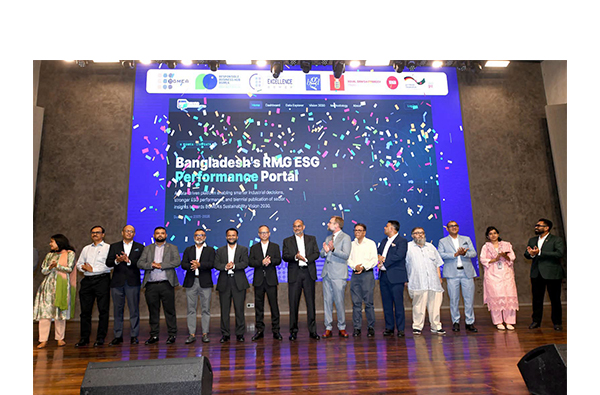
The Bangladesh Garment Manufacturers and Exporters Association (BGMEA) officially launched its ESG Platform (ESG Dashboard) for the readymade garment (RMG) sector at the Noorul Quader Auditorium, BGMEA Complex, Uttara, Dhaka.
The platform is expected to play a significant role in strengthening Environmental, Social and Governance (ESG) compliance in Bangladesh’s apparel industry and helping the sector meet evolving global requirements.
The inaugural ceremony was presided over by Mahmud Hasan Khan, President, BGMEA, with Dr. Rashed Al Mahmud Titumir, Adviser to the Ministry of Finance and the Ministry of Planning, Government of the People’s Republic of Bangladesh, attending as the Chief Guest.
The Special Guests included H.E. Christian Brix Møller, Ambassador of Denmark to Bangladesh; Dr. M. Masrur Reaz, Chairman and CEO of Policy Exchange Bangladesh; Professor Munshi Sulaiman, Research Director of the BRAC Institute of Governance and Development (BIGD), BRAC University; and Professor Matin Abdullah, Technical Lead of Mapped in Bangladesh (MIB). The welcome address was delivered by Sheikh Hossain Muhammad Mustafiz, Director, BGMEA.
Also present at the event were Inamul Haq Khan, Senior Vice President, BGMEA; Mijanur Rahman, Vice President (Finance), BGMEA; and Nafis-Ud-Doula, Director, BGMEA, along with other BGMEA leaders and general members.
In his address as Chief Guest, Dr. Rashed Al Mahmud Titumir stated that the government had provided USD 4.12 billion in subsidies to the energy sector over the preceding eight months. Referring to the previous government’s lack of effective measures, he noted that approximately eight million people had fallen below the poverty line. He identified three major challenges facing the government: a fragile economy inherited from the previous administration, inflationary pressures, and a lack of employment opportunities for educated young people.
He further stated that the government was working to build a capable and healthy Bangladesh by creating employment through increased investment in the manufacturing sector, expanding domestic revenue without increasing tax rates, and raising public expenditure on education and healthcare.
The Adviser also highlighted Bangladesh’s strong prospects of graduating from the Least Developed Country (LDC) category to a developing country in 2029. He expressed optimism that effective implementation of social protection initiatives, such as the Family Card programme, would significantly reduce poverty. He noted that Bangladesh was advancing with its own vision and reform agenda, which development partners were also observing. Praising BGMEA’s leadership, he added that BGMEA, BKMEA and BTMA were playing remarkable roles in implementing the government’s vision.
In his presidential address, Mahmud Hasan Khan, President, BGMEA, emphasized that local factories must become more compliant and data-driven to respond to changing global market demands and address the future challenges of sustainable apparel production. He stated that the newly launched ESG Platform would play an important role in assessing and improving the environmental, social and governance performance of BGMEA member factories.
He further noted that 326 factories had so far submitted reports through the platform, although this number remained insufficient. To safeguard the industry’s overall interests and strengthen compliance, the platform would soon be made mandatory for members. If necessary, BGMEA and BKMEA would work jointly to implement this requirement.
In his welcome address, Sheikh Hossain Muhammad Mustafiz, Director, BGMEA, who spearheaded the ESG Platform initiative, reflected on the journey that began in 2019. He emphasized that the RMG industry must move beyond viewing compliance as an obligation and transform it into a source of competitive advantage. Developed using data from 326 factories, the platform represents a significant milestone in promoting transparency and sustainability across the industry.
In his remarks, H.E. Christian Brix Møller, Ambassador of Denmark to Bangladesh, expressed Denmark’s full support for the government’s economic reform agenda. He emphasized the importance of implementing the July Charter through national unity, reconstruction and a successful transition towards establishing an effective parliamentary democracy, as part of Bangladesh’s ambition to build a trillion-dollar economy.
Dr. M. Masrur Reaz, Chairman and CEO of Policy Exchange Bangladesh, observed that the apparel industry lies at the heart of Bangladesh’s economy. He stressed that moving beyond conventional compliance towards sustainability has become essential for long-term development. He also underscored the importance of a strong export base in achieving Bangladesh’s development goals, noting that the approach of “ESG Data to Action” would contribute to long-term success.
Professor Munshi Sulaiman, Research Director of BIGD, BRAC University, emphasized the importance of bringing all BGMEA member factories under the ESG Platform to ensure wider participation and more comprehensive industry data.
The programme was moderated by Sheikh Suchita Jahan Sneha, Chief Coordinator, Responsible Business Hub and BGMEA Centre of Excellence.
The initiative received financial support from the Embassy of Denmark in Bangladesh, while technical assistance was provided by the BRAC Institute of Governance and Development (BIGD) and Mapped in Bangladesh (MIB). Following the ceremony, invited guests participated in a networking session.

Copyright © 2020, The Bangladesh Garment Manufacturers and Exporters Association.
Version-2.0, Design & Developed by Systech Digital Limited.
Version-2.0, Design & Developed by Systech Digital Limited.